With EV and plug-in hybrid versions launched together, JSW MG Motor India is making a broader statement about where it sees the country’s next phase of automotive growth.
India’s automotive industry is entering a more nuanced phase of electrification. The transition is no longer defined by a simple choice between internal-combustion engines and battery-electric vehicles. Consumers, manufacturers and policymakers are increasingly navigating multiple technology pathways.
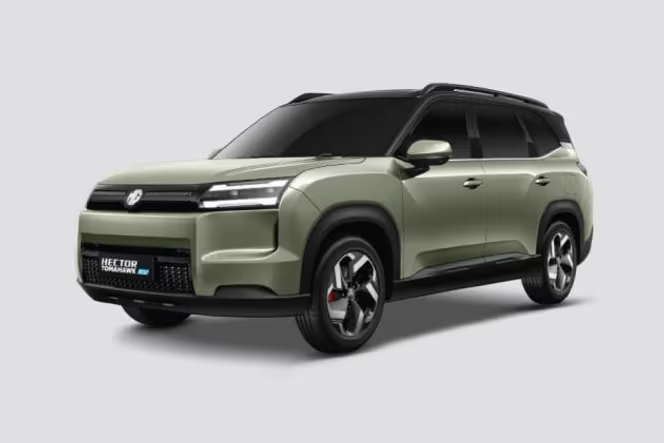
Against this backdrop, JSW MG Motor India’s launch of the Hector Tomahawk EV and Hector Tomahawk PHEV on August 26, 2026, is strategically significant. The company is bringing two electrified powertrains to the same SUV family, signalling a willingness to address different consumer requirements as India’s mobility ecosystem evolves.
Two Powertrains, One Strategic Direction
The Hector Tomahawk EV starts at ₹19.49 lakh ex-showroom and uses a 69.2 kWh battery, with MG claiming a 517 km MIDC range. It is available in five- and seven-seat configurations.
The PHEV takes a different route. It combines a 1.5-litre petrol engine with a 20.5 kWh battery, offering more than 115 km of claimed electric-only range and a claimed combined range of more than 1,100 km. The PHEV is priced from ₹25.69 lakh ex-showroom.
The significance lies in the choice itself. MG is not positioning electrification as a single technology pathway. Instead, the company is offering customers a choice between a pure EV and a plug-in hybrid within the same product family.
The ADAPT Advantage
Underpinning the strategy is MG’s ADAPT platform, which the company describes as a multi-new-energy-vehicle architecture capable of supporting EV, HEV, PHEV and range-extender technologies. The Hector Tomahawk becomes the first MG model in India based on this platform.
For the automotive industry, a flexible platform can be strategically important. It allows manufacturers to respond to changing consumer preferences and technology economics without developing an entirely separate architecture for every powertrain.
That flexibility could become increasingly valuable as India’s electrification journey develops at different speeds across cities, vehicle segments and customer groups.
Beyond the Vehicle
Another notable element is MG’s Battery-as-a-Service (BaaS) model. The Tomahawk EV can be purchased through a lower upfront-price structure beginning at ₹13.99 lakh plus battery rental, while the PHEV BaaS option starts at ₹21.79 lakh plus a per-kilometre battery rental charge.
The model reflects an industry-wide effort to rethink the economics of EV ownership. Battery costs remain an important component of electric-vehicle pricing, and alternative ownership models could help manufacturers experiment with ways of reducing the initial purchase barrier.
Localisation Will Be the Next Test
The launch also comes as JSW MG Motor India pushes deeper into localisation. The company has said it is targeting 70% localisation for the Windsor and Hector Tomahawk by the end of FY27, according to recent reporting.
That ambition matters because India’s long-term automotive opportunity is not simply about selling more electric vehicles. It is about building a stronger domestic ecosystem around batteries, electronics, components, software and advanced manufacturing.
Greater localisation can potentially strengthen supply-chain resilience while creating opportunities for Indian component manufacturers and technology suppliers.
What the Tomahawk Signals
The Hector Tomahawk arrives at an important moment for India’s automotive industry.
The next stage of mobility will be shaped by powertrain diversity, localisation, software, connected technologies, battery economics and charging infrastructure—not by one technology in isolation.
For JSW MG Motor India, the Tomahawk is therefore more than a new SUV launch. It is a strategic experiment in how an automotive company can combine EV technology, plug-in hybrid capability, flexible architecture and alternative ownership models for the Indian market.
The bigger question is whether consumers will embrace this multi-path approach.
If they do, the Hector Tomahawk could become an interesting indicator of where India’s electrified mobility market is heading next.
India’s automotive transition is accelerating—but the road to 2030 may have more than one lane.