
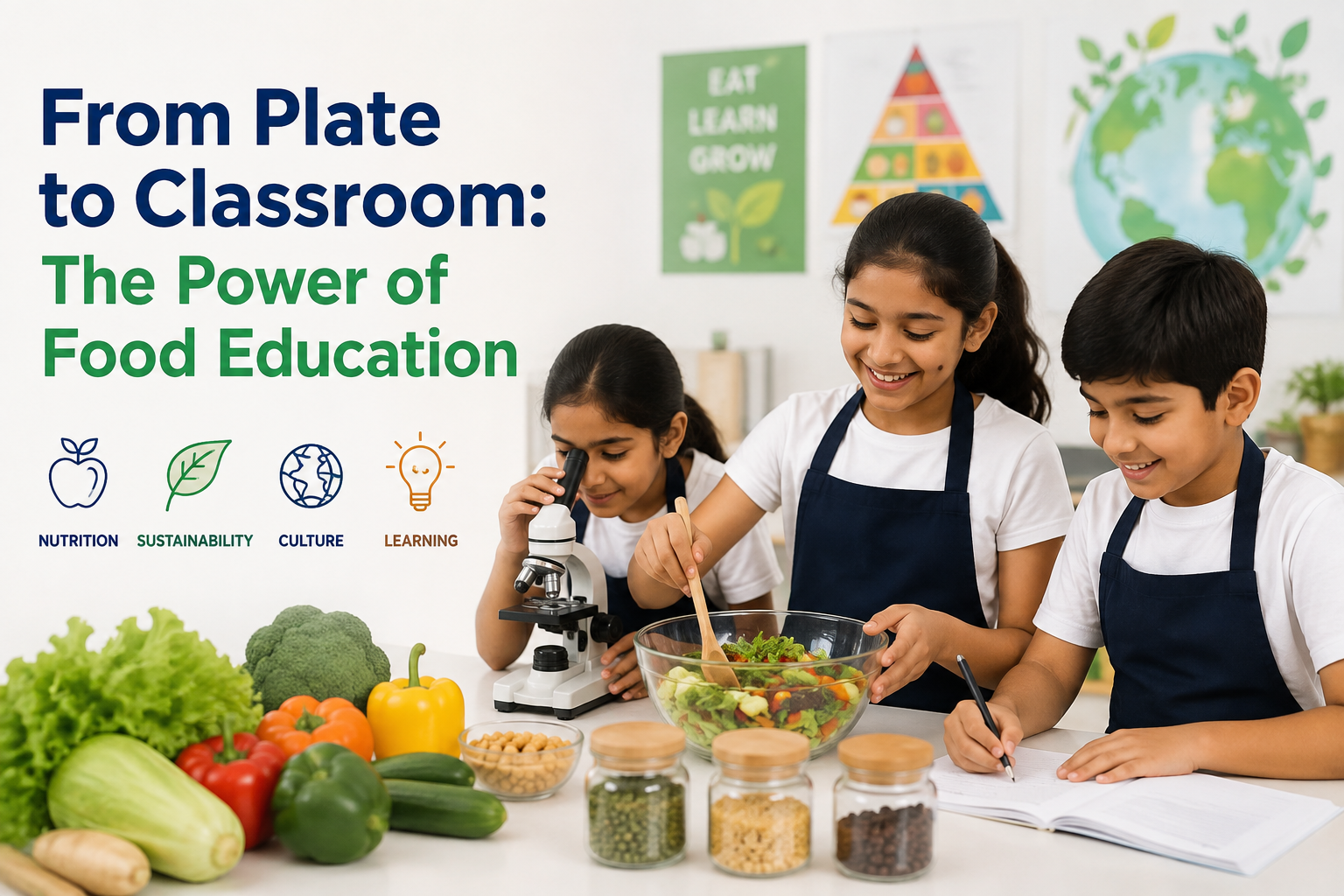
Food is often treated as something students simply consume or learn to prepare. But in education, it can become a powerful lens through which young people understand science, mathematics, health, culture, agriculture, economics and sustainability.
That is why Food Studies should be viewed as more than cooking lessons. Food literacy education can connect classroom knowledge with everyday decisions and help students understand the systems behind what appears on their plates.
Learning Through Food
Food provides a practical way to make academic concepts meaningful. Measuring ingredients can reinforce mathematical skills, while cooking can introduce students to chemistry, biology and food safety. Studying where ingredients come from can open discussions about agriculture, geography, climate and supply chains.
Research on food-literacy education has found strong support among education and food professionals for combining theoretical learning with practical activities. Suggested approaches include cooking, gardening, visits to food-related sites and interaction with industry professionals.
This interdisciplinary character is one of Food Studies’ biggest strengths. Instead of isolating knowledge into separate subjects, it allows students to see how different areas of learning connect.
Building Food Literacy
Knowing how to prepare a meal is only one part of food literacy. Students can also learn how to understand ingredients, evaluate food information, plan meals, consider budgets and recognise how food choices connect with health and the environment.
A food-literacy curriculum developed for high-school students, for example, combined agriculture, nutrition and cooking with practical activities involving food supply chains, food safety, budgeting and preparation.
Such skills can help students become more informed and independent decision-makers as they grow older.
Understanding Culture Through Food
Food also carries history and identity. Traditional dishes can introduce students to different communities, migration patterns, agricultural practices and cultural traditions.
A classroom discussion about a particular ingredient can therefore move far beyond its nutritional value. Students can explore where it originated, how it travelled across regions, how it is produced and how different communities use it.
Food education programmes have demonstrated how subjects such as history, science, social studies, arts and nutrition can be connected through food-based learning.
From Classroom to Food System
Modern Food Studies can go further still by introducing students to the wider food system.
Agriculture, processing, packaging, logistics, retail and waste management all form part of the journey from farm to consumer. Understanding this chain can help students appreciate the scale and complexity of the food industry while introducing ideas around sustainability and resource management.
This perspective is particularly relevant as the global food system faces challenges involving environmental sustainability, changing consumption patterns and resource efficiency.
Making Learning More Practical
The strongest case for Food Studies may be its ability to turn abstract knowledge into experience.
Students can observe, experiment, measure, discuss and reflect rather than simply memorising information. Research into food-literacy education has highlighted the importance of practical components alongside classroom learning.
Schools do not necessarily need to create an entirely separate subject. Food-related learning can be integrated into science, mathematics, social studies, health and environmental education.
A Curriculum for Real Life
Education ultimately prepares students not only for examinations but also for life beyond school. Food is one of the few subjects that touches everyone, every day.
Treating Food Studies as an interdisciplinary learning opportunity can help students connect classroom concepts with practical skills, culture, health, agriculture and the wider economy. The goal is not to turn every student into a chef. It is to create food-literate learners who understand what they eat, where it comes from and how their choices connect to the world around them.