
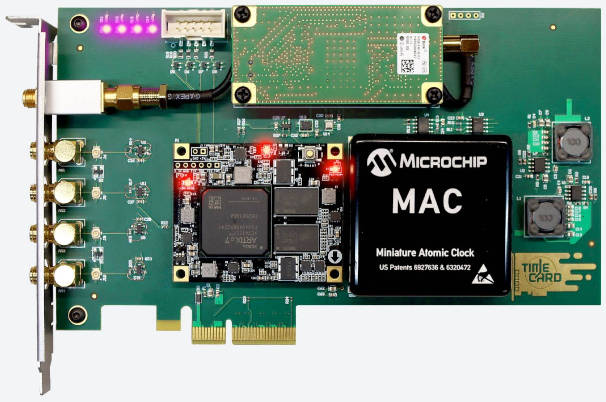
Space technology is entering a phase where precision is becoming as important as propulsion, connectivity and computing power. As satellite networks become more distributed and missions increasingly depend on real-time coordination, the ability to maintain reliable timing is emerging as a critical piece of space infrastructure.
Microchip Technology’s expansion of its atomic-clock portfolio with a radiation-tolerant space timing solution highlights this shift. While an atomic clock may appear to be a highly specialised component, its significance extends far beyond the device itself. It points to how the next generation of spacecraft will be designed—with greater emphasis on precision, resilience, miniaturisation and energy efficiency.
Timing Is Becoming Mission-Critical
Modern satellites are no longer isolated platforms. They increasingly operate as interconnected nodes within larger networks.
Communications satellites coordinate signals across multiple systems. Navigation platforms depend on extremely stable timing. Earth-observation missions synchronise complex operations, while satellite-to-satellite links require accurate coordination.
As these networks grow, timing errors can have consequences far beyond a single component.
This is why precision timing is becoming an increasingly strategic capability within the space electronics ecosystem.
The Miniaturisation Imperative
The space industry is undergoing a fundamental design change.
The growth of small satellites and commercially developed spacecraft is pushing manufacturers to achieve more functionality with less mass, power and physical space.
That creates an unusual engineering challenge: spacecraft are becoming smaller while their technological requirements are becoming more sophisticated.
Precision timing technologies must therefore follow the same trajectory.
The move toward compact atomic-clock solutions reflects the industry’s broader effort to bring capabilities once associated with larger and more expensive spacecraft into smaller platforms.
Radiation Resilience Becomes More Valuable
Space is unforgiving for electronics.
Radiation exposure can affect components over the lifetime of a mission, making resilience a fundamental consideration in spacecraft design.
As satellite missions become longer and more commercially important, manufacturers are increasingly looking for components that can combine performance with environmental resilience.
Radiation-tolerant timing technologies fit directly into this requirement.
The strategic opportunity for semiconductor companies lies in developing components that are not merely smaller, but capable of maintaining dependable performance under increasingly demanding operating conditions.
The Rise of Commercial Space Changes the Equation
The space industry is no longer dominated exclusively by government-funded missions.
Commercial satellite constellations, private communications networks, Earth observation and emerging space applications are changing the economics of spacecraft development.
Cost, deployment speed and scalability now matter alongside traditional measures of reliability.
That creates demand for technologies that can deliver space-relevant performance without necessarily following the cost and development models of traditional bespoke space hardware.
For component manufacturers, this is creating an important new market between conventional commercial electronics and highly specialised space-grade systems.
Precision Electronics Become Strategic
The most important technologies in the space economy will not always be the most visible.
Launch vehicles and satellites attract attention because they are the physical assets. But the performance of those systems increasingly depends on specialised electronics hidden deep inside their architecture.
Timing, frequency control, power management, sensors and radiation-tolerant processing are becoming strategic technologies in their own right.
Companies that can combine commercial-scale manufacturing with space-specific engineering expertise could therefore find themselves in an increasingly attractive position.
A New Competitive Battlefield
Microchip’s latest move also illustrates a broader competitive shift within the semiconductor industry.
The opportunity is no longer limited to supplying processors or memory. Semiconductor companies are increasingly targeting highly specialised applications where performance requirements create higher barriers to entry.
Space is particularly attractive because qualification, reliability and environmental requirements make specialised components difficult to replace once they become embedded in a system architecture.
That can create longer-term customer relationships and opportunities for technology differentiation.
What Comes Next
The future of satellite technology will demand more than smaller spacecraft.
It will require spacecraft that can communicate, navigate, synchronise and operate autonomously with greater precision and reliability.
That puts timing technology in an increasingly important position.
Microchip’s expansion of its atomic-clock portfolio should therefore be viewed as part of a much broader industry movement: the migration of sophisticated precision technologies into smaller, smarter and more commercially viable space systems.
The next space race may be dominated by rockets and satellite constellations in the headlines.
But underneath those systems, a quieter race is taking place—for the electronics capable of making increasingly complex missions work.
And in that race, precision timing could become one of space technology’s most strategically important building blocks.