
Raising money is not the same as raising the right money. For a startup, the wrong source of capital at the wrong stage can create financial pressure, unnecessary dilution or restrictions on future growth. Funding should therefore be treated as a strategic business decision rather than simply a way to bring more money into the company.
Today’s founders have several funding options, including bootstrapping, friends and family, angel investors, seed funding, government-backed programs, bank loans, venture debt and venture capital. Each source serves a different purpose. Some provide capital while allowing founders to retain control, while others bring investors, networks, expertise or strategic partnerships along with the money.
The right funding strategy also changes as the startup develops. An entrepreneur testing an idea may need relatively limited capital and maximum flexibility. A startup with early customers may need funding to build its team and product. A revenue-generating company may have more financing choices, while a business preparing for rapid expansion may require substantial growth capital.
Funding Starts With the Startup Stage
At the idea stage, the immediate priority is usually validation. Founders need to understand whether there is a genuine market problem, whether customers are willing to pay and whether the business model can work. Bootstrapping can be useful because it allows founders to test the concept without immediately giving away ownership. Friends and family may also provide early capital when conventional financing is difficult to access. Incubators and accelerators can add mentoring, networks and, in some cases, funding.
Once the startup gains early traction, the capital requirement often increases. The business may need to hire employees, improve its technology, expand sales or acquire customers. Angel investors and seed funding can become relevant at this stage. Beyond capital, experienced investors can potentially bring industry knowledge, connections and strategic guidance.
Revenue Opens New Funding Options
A startup with predictable revenue and stronger cash flows may have access to a broader range of financing. Bank loans can support working capital, inventory, machinery and business expansion, provided the company can comfortably manage repayment.
Venture debt can also be considered by certain venture-backed startups that need additional capital without immediately raising another significant equity round. However, debt creates repayment obligations, making cash-flow planning essential.
Scaling Requires Strategic Capital
When a startup has proven demand and is ready to expand, venture capital, growth capital and strategic investment can support larger ambitions. Strategic investors may offer more than money, including distribution capabilities, technology, industry relationships and access to new markets.
This makes the funding decision more strategic. The question is no longer simply where to find capital, but which capital can create the greatest value for the business.
Debt or Equity?
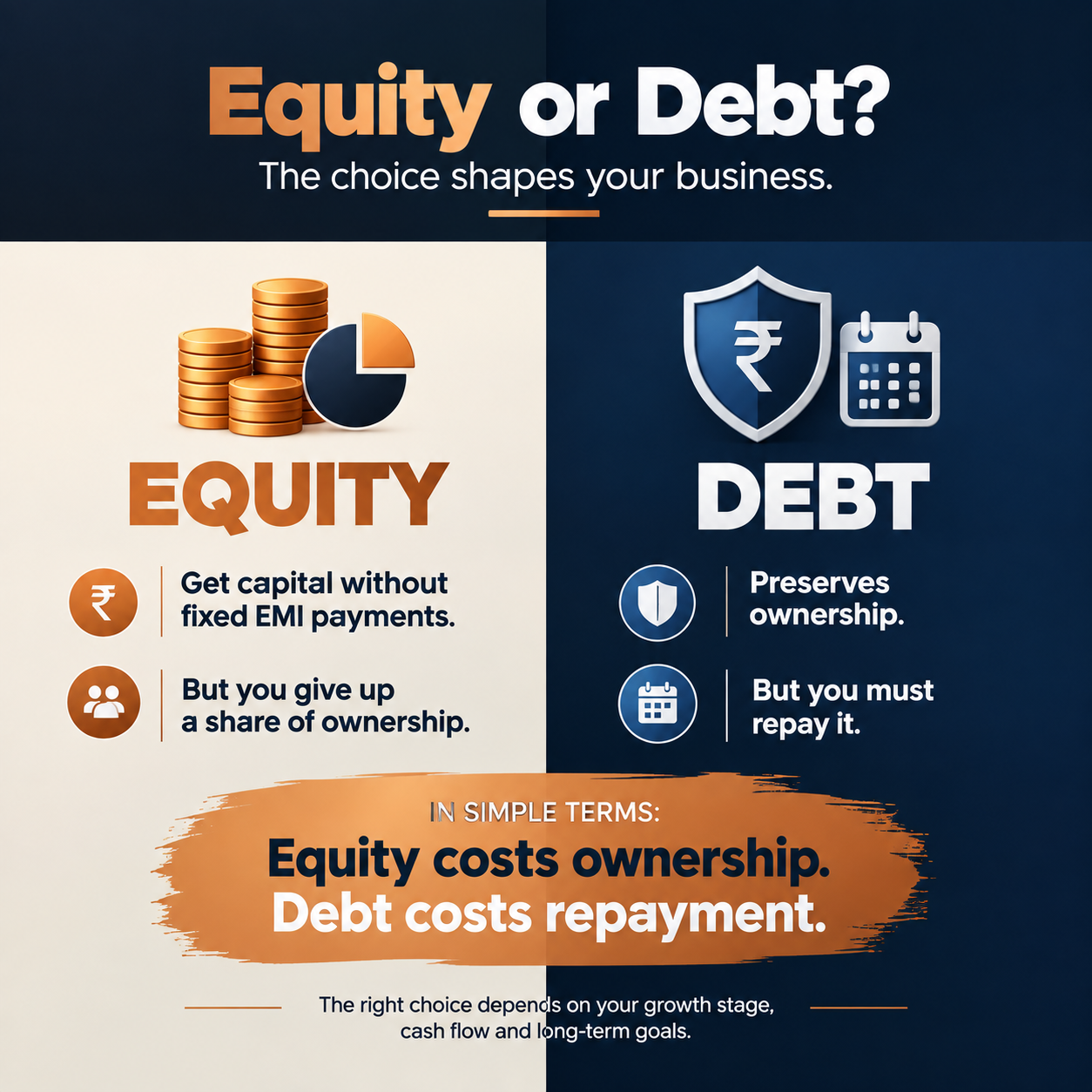
The fundamental choice often comes down to debt versus equity. Equity provides capital without the same fixed repayment obligation as a loan, but founders give up a portion of ownership. Debt allows founders to retain ownership, but creates a financial repayment commitment.
Neither option is automatically better. The right choice depends on the startup’s cash flow, growth prospects, capital requirement, risk profile and willingness to dilute ownership.
Choose Capital With a Clear Purpose
Before raising funds, founders should ask five questions: What stage is the startup in? How much capital is actually required? What will the money achieve? Can the business comfortably manage debt repayments? How much ownership is the founder willing to give up?
The cheapest money is not always the best money. The right funding is the capital that matches the startup’s stage, supports its growth objectives and strengthens the business without creating unnecessary financial or ownership pressure.