
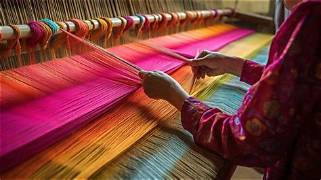
India’s handloom sector stands at an important crossroads. With millions of people dependent on the industry for livelihoods, expanding access to domestic and international markets could play a significant role in strengthening one of the country’s most important traditional manufacturing ecosystems.
President Droupadi Murmu has highlighted the potential of e-commerce platforms to take Indian handloom products to global consumers, underlining how digital commerce can connect artisans directly with markets beyond their traditional geographic boundaries.
The sector provides employment to around 35 lakh people, with more than 25 lakh women actively engaged in handloom-related activities. These numbers make the industry more than a cultural heritage sector—it is an important contributor to employment, particularly for women and communities in rural and semi-urban areas.
Digital Commerce as a Market-Access Tool
For generations, handloom artisans have faced challenges in reaching large markets. Dependence on intermediaries, limited geographical reach and inconsistent access to customers have restricted the commercial potential of many traditional products.
E-commerce can change this equation. Digital platforms can enable artisans, cooperatives and small enterprises to showcase products to consumers across India and overseas without requiring a physical retail presence in every market.
However, achieving global scale will require more than simply listing products online. Packaging, quality standards, logistics, digital payments, branding and intellectual-property protection will become increasingly important as Indian handloom competes in international markets.
Women at the Centre of the Sector
The participation of more than 25 lakh women gives the handloom industry an important socioeconomic dimension. Strengthening this ecosystem can contribute to greater economic participation and income opportunities for women, particularly in regions where alternative employment opportunities may be limited.
Digital access could further strengthen this role by enabling women-led artisan enterprises and producer groups to build direct relationships with customers and develop their own brands.
Preserving Heritage While Building a Modern Industry
The presentation of the Sant Kabir and National Handloom Awards also highlights the importance of recognising craftsmanship alongside commercial development.
India’s challenge is to ensure that modernisation does not dilute the identity and heritage that make its handloom products distinctive. Instead, technology and e-commerce should become tools for preserving that heritage while creating sustainable economic opportunities.
The future of Indian handloom may therefore depend on its ability to combine traditional craftsmanship with modern market access. If digital platforms, government initiatives and industry stakeholders can build an efficient ecosystem around artisans, India’s handloom sector could move from being primarily a heritage industry to becoming a globally competitive creative manufacturing sector.
That transition could deliver not only export opportunities, but also more inclusive and sustainable economic growth.