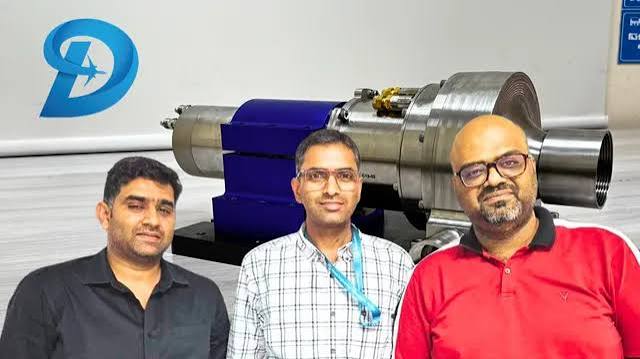
DheyaTech, a small deep-tech startup building indigenous gas turbine engines, has just raised ₹43 crore led by Avaana Capital, with backing from Unimech Aerospace and Manufacturing. On the surface, it’s a modest funding round — not the kind of headline-grabbing mega-raise that dominates startup news cycles. But look closer, and this is arguably one of the more consequential deep-tech bets in India right now.
The Real Story Isn’t the Money — It’s the Dependency It’s Trying to Break
For decades, India has been almost entirely dependent on imported propulsion technology for its aerospace, defence, and energy needs. Small gas turbine engines — the compact systems that generate thrust or power by burning fuel and spinning turbine blades at extreme speed — are used everywhere from aircraft and drones to distributed power grids. Yet despite India’s growing ambitions in defence manufacturing and aerial mobility, the country has lacked serious indigenous capability in this space.
That’s not a small gap. Fewer than a dozen countries worldwide currently possess the expertise to design and manufacture small gas turbines domestically. It’s a brutally difficult engineering problem — one that demands mastery across turbomachinery, combustion science, high-temperature materials, and precision manufacturing simultaneously. This isn’t a space where you can move fast and break things; it’s a space where you move carefully, or you don’t move at all.
Why DheyaTech’s Pedigree Actually Matters Here
It’s worth noting who’s behind this. DheyaTech was founded by aerospace engineers with over 15 years of experience at GE Aviation and Rolls-Royce — companies that sit at the very top of global turbine engineering. That’s not a trivial detail. In deep-tech hardware, unlike software, credibility is earned through years of hands-on engineering experience, not just a good pitch deck. Investors backing DheyaTech aren’t betting on an idea; they’re betting on a team that has already built this technology inside the world’s most demanding aerospace companies.
What’s genuinely compelling is how DheyaTech plans to spend this capital. Rather than chasing growth-at-all-costs, the company is funneling the money into unglamorous but essential fundamentals: scaling manufacturing capacity and building a fully integrated engine-testing facility. This is the unsexy, capital-intensive work that deep-tech hardware companies have to do — and too often, Indian startups in this space struggle to get funded for exactly this reason. Software gets celebrated. Hardware gets ignored. DheyaTech’s raise is a small but meaningful signal that Indian investors are starting to understand the difference — and are willing to fund the slow, expensive slog required to build real engineering capability.
The Hydrogen Bet Adds a Forward-Looking Layer
DheyaTech isn’t just building conventional turbines — it’s simultaneously pushing into hydrogen propulsion, including a hydrogen blower with ATEX safety certification and a hydrogen-based flexi-fuel combustor developed with IISc Bengaluru for a 60-kW turbogenerator. This positions the company not just as an import-substitution play, but as a potential player in the next generation of clean propulsion and power systems — a space where, notably, no country has a decades-long incumbent advantage the way legacy players dominate conventional turbines.
What to Watch Next
The real test comes in Q4 2026, when DheyaTech has targeted flight trials for its engines. The company says it already has confirmed orders from Indian and global OEMs — a claim that, if it holds up, would mark a genuine transition from R&D to commercial traction. That’s the moment that will determine whether this ₹43 crore round looks, in hindsight, like the early innings of India building a strategically important industrial capability — or another promising deep-tech story that stalled at the prototype stage.
For now, though, it’s hard not to see this as a positive signal: capital, engineering talent, and national strategic interest converging around a genuinely hard problem. That combination doesn’t come along often in Indian deep-tech — which is exactly why it’s worth paying attention to.