
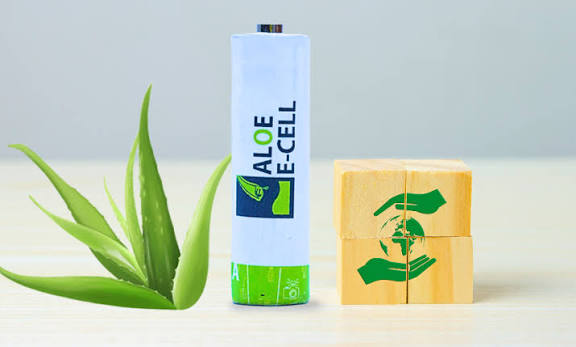
What if one of the most familiar products in our homes—an everyday battery—could be redesigned using a plant-based electrolyte?
That is the idea behind Aloe Ecell, an Indian clean-tech venture founded by Naveen Suman and Nimisha Varma. The company has developed dry-cell batteries using an aloe-vera-based herbal electrolyte, aiming to offer a more environmentally conscious alternative to conventional batteries.
Its product portfolio has focused on 1.5V AA and AAA batteries, the formats commonly used in remote controls, clocks, toys and other everyday electronic devices.
Turning a Plant Into Battery Technology
The interesting part of Aloe Ecell’s approach is not simply the use of aloe vera. It is the attempt to apply bioprocessing and electrochemistry to develop a battery electrolyte with a bio-based formulation.
Traditional batteries have long raised environmental concerns because of the materials used in their manufacture and the challenges associated with responsible disposal.
Aloe Ecell’s proposition is therefore built around a broader question:
Can battery performance and environmental responsibility coexist in an everyday, affordable product?
The company has promoted its batteries as eco-friendly and has claimed improved durability compared with conventional dry cells. Such claims, however, ultimately need to be evaluated through independent testing at scale, particularly across performance, shelf life, cost and recycling.
Why This Matters
Battery innovation is no longer limited to electric vehicles and grid-scale storage.
The global transition toward electrification is also forcing industries to rethink the materials, chemistry and lifecycle of batteries used across smaller applications.
That makes innovations in bio-based materials, safer chemistries and battery recycling increasingly relevant.
For India, this is particularly important. The country is trying to build domestic capabilities across the entire battery value chain, from raw materials and cells to recycling and advanced energy storage.
Startups experimenting with alternative materials can contribute to that ecosystem—even when their initial products target relatively small applications.
From Product to Circular-Economy Opportunity
The bigger opportunity for Aloe Ecell could lie beyond selling individual batteries.
If bio-based battery technology can be combined with effective collection, recycling and material recovery, the company could potentially develop a more complete circular battery ecosystem.
That would shift the proposition from simply making a “greener battery” to addressing a much larger problem:
What happens to a battery after it has powered a device?
That question will become increasingly important as battery consumption grows.
The Road Ahead
The biggest challenge for any alternative battery technology is balancing performance, affordability, scalability and environmental impact.
Consumers may appreciate a greener product, but mass adoption ultimately depends on whether it performs reliably and competes effectively on price.
Aloe Ecell’s journey is therefore worth watching—not because aloe vera alone will transform the battery industry, but because it represents a broader movement toward rethinking everyday technologies through sustainable materials and chemistry.
The next generation of clean technology may not always come from replacing an entire product.
Sometimes, changing what is inside it can be the beginning of something much bigger.