

Indian space-tech company Agnikul Cosmos has inaugurated two specialised facilities in Chennai, strengthening its capabilities in rocket-stage testing, inspection and the in-house manufacturing of critical launch-vehicle components.
The new facilities — the Stage Testing and Inspection Facility (STIF) and the Pressurant Tank Realization, Over-wrapping and Outfitting Facility (PROOF) — are part of Agnikul’s efforts to build infrastructure supporting advanced and reusable launch-vehicle technologies.
Advancing Stage-Level Testing
The Stage Testing and Inspection Facility (STIF) has been designed and fabricated in-house by Agnikul to test complete rocket stages under flight-like operating conditions.
The facility allows stage-level testing with propulsion and avionics integrated. This includes testing configurations involving clusters of Agnikul’s semi-cryogenic, electric-pump-fed engines, which use the company’s 3D-printing technology.
STIF is also intended to support the inspection and requalification of recovered rocket stages. This capability is important for reusable launch systems, where hardware must undergo detailed assessment following a flight before it can potentially be prepared for another mission.
Agnikul describes the broader objective as a “build–test–fly–recover–inspect–requalify–and-fly-again” cycle.
Bringing Critical Manufacturing In-House
The second facility, PROOF, expands Agnikul’s capabilities in the manufacturing and processing of high-pressure composite components.
The facility focuses on the realisation, over-wrapping and outfitting of pressurant tanks and other high-pressure composite vessels used in launch vehicles.
Developing these capabilities internally can give Agnikul greater control over manufacturing quality, production timelines and engineering iterations. It also forms part of the company’s wider strategy of increasing vertical integration across its rocket-development programme.
Agnikul already manufactures its single-piece, 3D-printed semi-cryogenic engines in-house and develops several critical propulsion, avionics and vehicle systems internally.
Building the Infrastructure for Reusability
Reusable rockets require an ecosystem of capabilities beyond launch itself. After a vehicle or stage returns from flight, engineers need to inspect the hardware, assess its condition, identify any degradation and determine whether it can be safely requalified for another mission.
This makes testing and inspection infrastructure a critical component of any serious reusable-launch programme.
Agnikul’s new facilities are intended to strengthen this capability as the company progresses with its launch-vehicle development programme and prepares for its second mission.
However, the inauguration should not be interpreted as evidence that Agnikul already has a proven, operational reusable orbital rocket. The facilities are part of the company’s ongoing technology-development, testing and validation efforts.
A Milestone for India’s Private Space Sector
The development comes as India’s private space ecosystem moves toward increasingly sophisticated launch-vehicle manufacturing and testing capabilities.
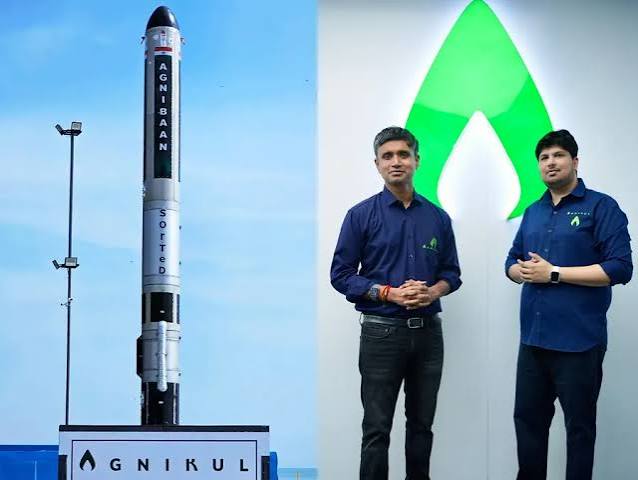
Agnikul’s first mission, Agnibaan SOrTeD, was successfully launched on May 30, 2024. The mission demonstrated the company’s propulsion and avionics technologies, including its single-piece 3D-printed semi-cryogenic engine.
The new infrastructure builds on that technology base by adding dedicated capabilities for complete-stage testing, inspection and critical composite-component manufacturing.
The facilities were inaugurated in the presence of Group Captain Shubhanshu Shukla, the Indian astronaut and member of India’s human spaceflight programme.
Beyond Rocket Manufacturing
The significance of Agnikul’s expansion goes beyond the addition of two facilities.
For commercial space companies, the ability to control more stages of the engineering and manufacturing process can help reduce dependence on external suppliers, improve development cycles and accelerate design iterations.
For India, the growth of such capabilities can contribute to a deeper private aerospace ecosystem involving advanced materials, propulsion, electronics, composites, testing equipment and specialised engineering services.
As launch demand increases globally, the ability to manufacture, test and qualify launch vehicles efficiently will become increasingly important.
Agnikul Cosmos’ Chennai expansion signals an important evolution in India’s private space industry — from developing individual rocket technologies to building the infrastructure required to test, inspect and manufacture increasingly sophisticated launch vehicles.
STIF and PROOF strengthen the company’s capabilities across critical parts of the launch-vehicle lifecycle. More importantly, they support Agnikul’s longer-term ambition of developing a repeatable build–test–fly–recover–inspect–requalify model.
The road to reusable rockets remains technically demanding, but the infrastructure being built today could prove just as important as the rockets themselves.
For India’s emerging commercial space sector, Agnikul’s latest investment is another step toward a more integrated, scalable and technologically capable aerospace manufacturing ecosystem.