
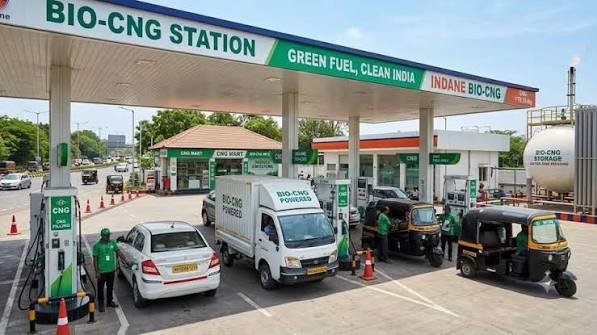
India’s clean-fuel transition is entering a new phase. After blending ethanol into petrol, the government is now putting greater emphasis on compressed biogas (CBG), often referred to as Bio-CNG, as a potential alternative to conventional natural gas in transport and industry.
A proposed government push of around ₹23,731 crore could accelerate the development of the CBG ecosystem, from feedstock collection and production to distribution and vehicle adoption. If implemented effectively, the initiative could reshape how India thinks about the fuel powering its CNG vehicles in the coming years.
Turning Waste Into Fuel
The biggest attraction of Bio-CNG is its ability to convert organic waste into usable energy.
Agricultural residue, cattle dung, municipal waste and other biodegradable materials can be processed to produce biogas, which is then purified and compressed for use as vehicle fuel.
For India, this creates an opportunity to address two challenges at once: waste management and energy security.
Instead of allowing agricultural and organic waste to become an environmental burden, the country can potentially turn it into a domestic source of transportation fuel.
A New Opportunity for Rural Economies
The Bio-CNG opportunity extends beyond fuel stations and automobile manufacturers.
A larger CBG ecosystem could create demand for agricultural residue, waste collection, processing infrastructure, logistics and local energy services. This could generate additional income opportunities for farmers and rural businesses while creating new industrial activity around waste-to-energy projects.
The success of the model, however, will depend on reliable feedstock supply and commercially viable collection systems.
What It Could Mean for CNG Vehicles
For consumers, the transition could be relatively seamless because purified CBG can be used in applications designed for compressed natural gas.
That makes Bio-CNG particularly interesting compared with completely new vehicle technologies that require major changes in infrastructure or consumer behaviour.
The bigger challenge is scale.
For Bio-CNG to become a meaningful part of India’s transport-fuel mix, production capacity, compression facilities, pipelines or transportation networks and retail availability will all need to expand together.
Reducing Dependence on Imported Gas
India’s energy strategy is increasingly focused on reducing dependence on imported fossil fuels.
Domestic production of Bio-CNG could support this objective by adding a renewable source to the country’s gas ecosystem. It could also diversify India’s fuel mix at a time when energy demand is expected to continue rising.
However, Bio-CNG is unlikely to replace conventional CNG overnight. Feedstock availability, project economics, transportation costs and the reliability of supply will determine how quickly the sector can scale.
From Fuel Policy to Industrial Opportunity
The significance of the ₹23,731-crore push goes beyond what eventually reaches a vehicle’s fuel tank.
It could create an emerging industrial ecosystem involving waste management, agriculture, biotechnology, gas distribution, equipment manufacturing and clean mobility.
India’s ethanol experience demonstrated how a fuel-blending programme can influence agriculture, energy markets and consumer mobility simultaneously. Bio-CNG could create a similar ripple effect—if policy support is matched by infrastructure and private investment.
The real test will be execution.
If India can build a reliable supply chain from farm waste and organic waste to fuel stations, Bio-CNG could become more than an alternative fuel. It could become an important part of India’s broader strategy for cleaner mobility, rural income generation and greater energy independence.