
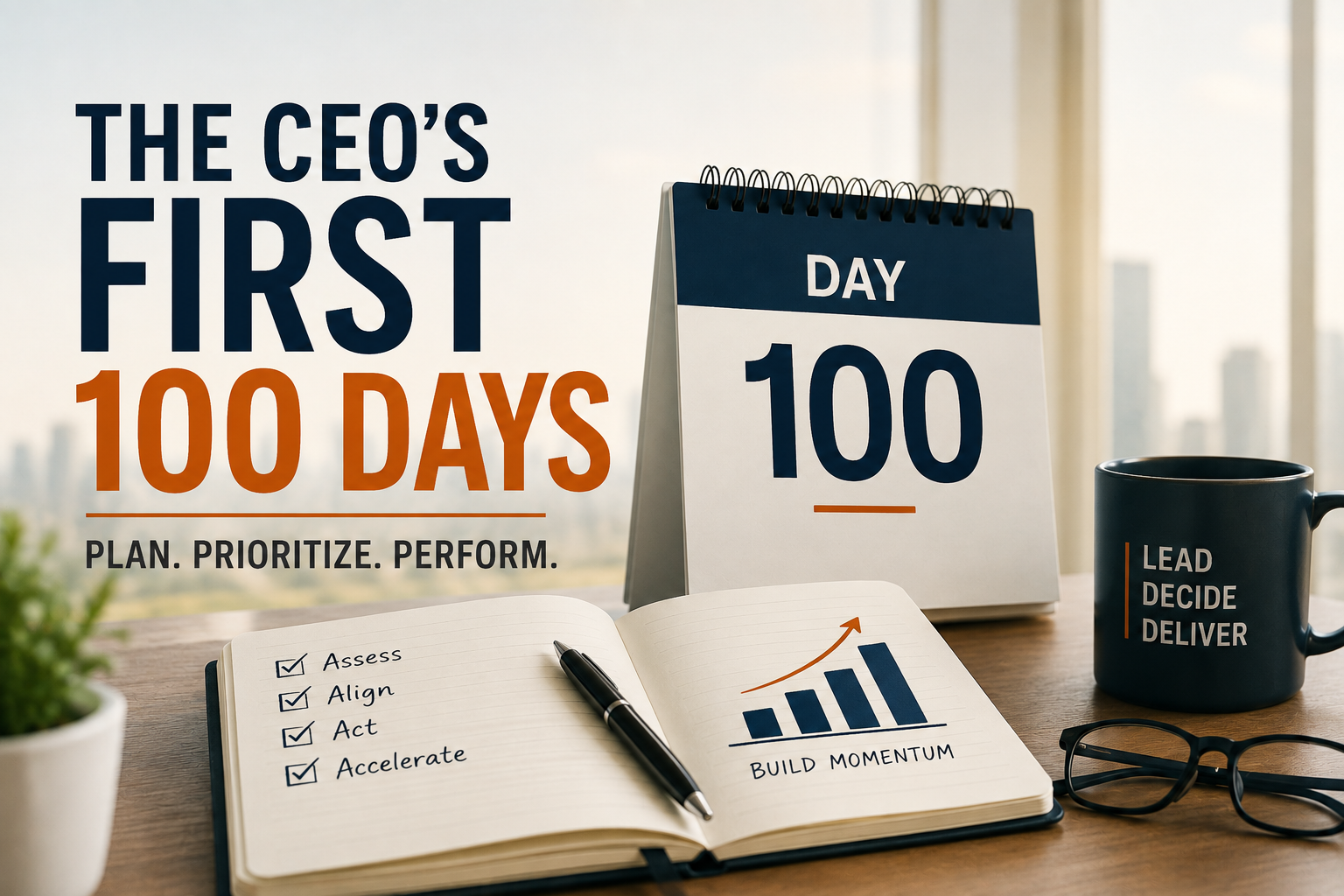
A new CEO rarely walks into a blank canvas. They inherit a business with an existing strategy, culture, leadership team, customers, investors and, often, unresolved challenges. That makes the first 100 days less about making dramatic changes and more about understanding the organisation before deciding where to intervene.
For a new leader, the early months can establish the foundation for years ahead.
1. Listen Before You Change
The first priority should be understanding the organisation.
A new CEO should engage with employees across functions, key customers, suppliers, investors and the leadership team. These conversations can reveal gaps between what the organisation believes is happening and what is actually happening on the ground.
The objective is not to arrive with all the answers, but to identify the right questions.
2. Understand the Numbers
Strategy cannot be separated from financial reality.
A CEO should quickly develop a clear view of revenue growth, margins, cash flow, debt, capital allocation, customer concentration and the performance of individual business units.
The question is simple: Where is value being created, and where is it being lost?
3. Assess the Leadership Team
A CEO inherits people as well as processes.
The first 100 days should include an honest assessment of the leadership team—its capabilities, accountability, collaboration and ability to execute the company’s strategy.
Not every leadership change needs to happen immediately. But every CEO needs to know who can deliver the next phase of growth.
4. Identify the Critical Few Priorities
One of the biggest mistakes a new CEO can make is trying to change everything at once.
The better approach is to identify three to five priorities that can materially influence the organisation’s performance.
These could include improving profitability, entering a new market, strengthening manufacturing capacity, accelerating digital transformation or rebuilding customer confidence.
Focus creates momentum.
5. Build Trust Through Communication
Employees closely watch a new CEO.
What the leader says, what they ask about and what they choose to measure sends powerful signals about the company’s direction.
Clear and consistent communication can reduce uncertainty and help employees understand not only what is changing, but also why it is changing.
6. Find the Quick Wins—Without Chasing Them
Early wins can build credibility, but they should not become the primary objective.
A quick improvement in an inefficient process, customer experience or internal decision-making system can demonstrate that leadership is listening and acting.
However, sustainable leadership is ultimately measured by structural improvements, not short-term optics.
7. Establish the Long-Term Direction
By the end of the first 100 days, a CEO should have greater clarity about the organisation’s strengths, weaknesses and opportunities.
That understanding should translate into a clear leadership agenda: where the company is going, what needs to change and how success will be measured.
The first 100 days are therefore not a deadline for transformation. They are the beginning of it.
The Leadership Lesson
The most effective CEOs do not use their first 100 days simply to make an impression. They use them to listen deeply, understand the business, build trust and establish priorities.
The strongest start is rarely the loudest one. It is the one that creates clarity for the organisation and confidence in the direction ahead.