
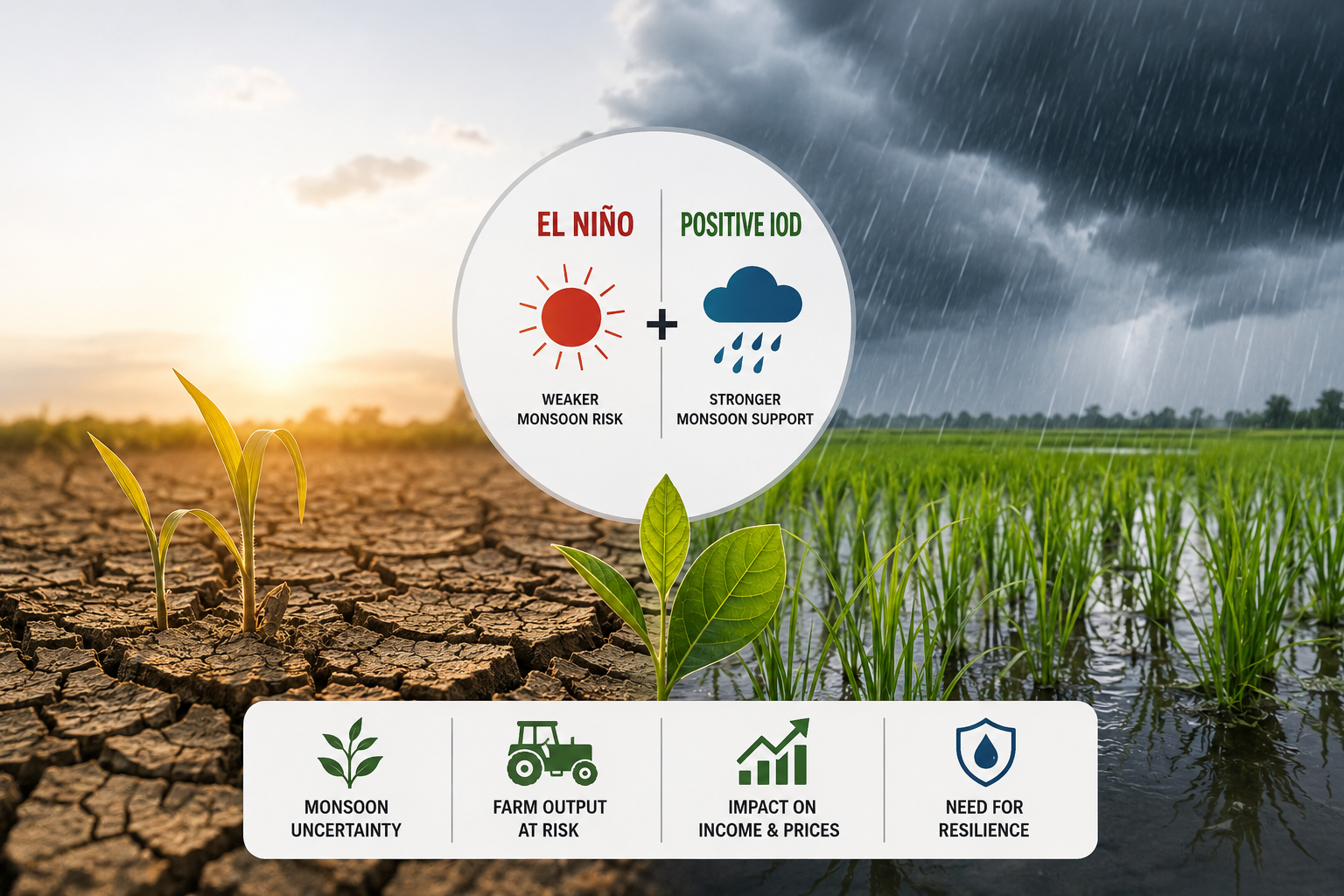
India’s agricultural economy could face another test as El Niño is expected to intensify through October, raising concerns over the progress of the monsoon and its impact on farm production. With agriculture still closely linked to rainfall patterns, any prolonged disruption could have consequences extending from rural incomes to food prices and consumer demand.
The potential risk is particularly significant because the monsoon remains a critical source of water for Indian agriculture. A weaker or uneven rainfall pattern can affect sowing decisions, crop yields, reservoir levels and irrigation availability, particularly in rain-dependent farming regions.
El Niño Puts the Monsoon Under Pressure
El Niño is associated with changes in Pacific Ocean temperatures that can influence global weather patterns, including India’s monsoon. An intensifying event through October could therefore increase uncertainty for farmers during an important period of the agricultural calendar.
The impact, however, is unlikely to be uniform across crops or regions. Irrigated areas may be better positioned to absorb rainfall variability, while rain-fed agriculture could face greater exposure.
For farmers, the key issue is not simply how much rain India receives, but when, where and how evenly it arrives.
Indian Ocean Dipole Offers a Potential Counterbalance
There is a positive factor in the outlook. A positive Indian Ocean Dipole (IOD) can potentially moderate some of the adverse influence of El Niño on India’s monsoon.
This does not eliminate the risk. Weather systems are influenced by multiple interacting factors, and the strength and timing of both El Niño and the IOD will determine their combined impact.
For policymakers and agricultural markets, this means the monsoon outlook needs to be monitored dynamically rather than assessed through a single climate indicator.
Beyond Farm Production
A weaker monsoon can have consequences well beyond the farm sector. Lower crop output can tighten supplies of agricultural commodities, potentially contributing to food-price pressures. Reduced rural incomes can also affect demand for consumer goods, automobiles, farm equipment and other products.
This makes monsoon performance an important economic variable for businesses and policymakers alike.
For India’s food industry, maintaining adequate stocks and resilient procurement networks will be particularly important if weather-related disruptions affect major crops.
Building Climate-Resilient Agriculture
The growing frequency and unpredictability of weather risks reinforce the need for greater agricultural resilience. Better irrigation, water conservation, climate-resilient crop varieties, weather forecasting and improved farm-level information can reduce farmers’ dependence on favourable rainfall conditions.
The immediate outlook will depend on how El Niño and the positive IOD evolve through the coming months. But the larger lesson is clear: India’s agricultural competitiveness increasingly depends on its ability to manage climate variability rather than simply respond to it.
For the farm sector, food companies and the wider economy, the monsoon remains more than a weather story—it is a critical component of India’s economic resilience.