
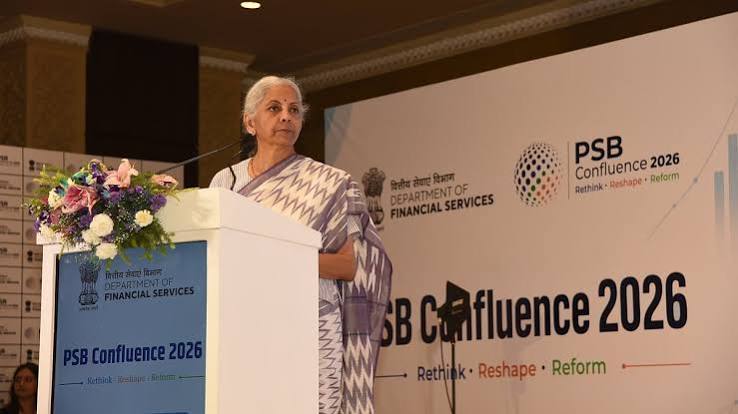
PSB Confluence 2026 puts growth, financial inclusion and stronger public-sector banking at the centre of India’s next economic phase.
India’s banking sector is entering an important phase. As credit demand expands and the economy creates new opportunities across businesses, agriculture and emerging sectors, public sector banks are being called upon to play a larger role in supporting growth while widening access to financial services.
The recently concluded PSB Confluence 2026, organised by the Department of Financial Services, brought together public sector banks, public financial institutions, government stakeholders and experts to discuss the priorities shaping the sector’s next chapter. The discussions resulted in actionable strategies across seven themes, reflecting a broad approach to banking-sector growth.
Banking Growth With a Wider Purpose
The role of public sector banks is evolving.
Beyond traditional lending and deposit mobilisation, PSBs are expected to support investment, strengthen credit delivery and expand banking access. This makes their ability to combine commercial performance with wider economic priorities increasingly important.
The Confluence’s agenda reflected this broader role, covering areas including deposit mobilisation, banking for youth, support for the investment cycle, global capability centres, agriculture and horticulture value-chain infrastructure, priority-sector lending and the credit-card business.
Bringing a New Generation Into Banking
One of the notable priorities emerging from PSB Confluence 2026 is the focus on young customers.
India’s young population represents a significant opportunity for the banking sector. Bringing younger consumers into formal banking early can help create long-term relationships while improving financial awareness and access.
The focus on “Banking for Youth” also points toward a more proactive approach to customer engagement, with banks encouraged to take banking services and awareness closer to educational and skill-development institutions.
Supporting the Investment Cycle
Banks also have an important role in enabling India’s next investment cycle.
As businesses expand and new investment opportunities emerge, efficient credit delivery can help translate economic potential into actual capacity, jobs and enterprise growth.
This is particularly relevant for sectors and businesses that require access to timely finance. A stronger connection between banking institutions and the investment ecosystem can therefore support broader economic momentum.
Financial Inclusion Remains Central
Growth cannot be sustainable if access to financial services remains uneven.
Priority-sector lending and support for agriculture and rural value chains remain important areas for ensuring that credit reaches segments that are critical to India’s economic development. The Confluence’s focus on these areas reinforces the continuing importance of inclusive credit delivery.
Financial inclusion is increasingly about more than opening bank accounts. It is about making credit, payments and financial products more accessible and useful to individuals and businesses.
The Digital Opportunity
Technology will remain a key enabler of this transformation.
For public sector banks, digital capabilities can help improve customer experience, expand reach and make banking services more efficient. But the opportunity lies in combining technology with accessibility and trust.
The future of banking will therefore require PSBs to be both technology-enabled and customer-focused.
A Stronger Role for Public Sector Banks
PSB Confluence 2026 sends a positive message about the role public sector banks can play in India’s next phase of development.
The seven-point action-oriented approach shows that the focus is moving beyond individual banking products toward broader questions of growth, investment, inclusion, youth engagement and competitiveness.
The challenge now is execution.
If India’s public sector banks can translate these priorities into faster credit delivery, stronger customer engagement and wider financial access, they can become an even stronger engine of economic opportunity.
The future of Indian banking is not only about growing balance sheets. It is about enabling more people, businesses and sectors to participate in India’s growth story.
PSB Confluence 2026 provides a clear direction: stronger banks, wider access and a more inclusive growth ecosystem can move together.