The most dangerous person in a growing company may not be its weakest employee. It may be the leader who believes every important decision needs their approval.
Control can look like leadership—until the organisation becomes too large for one person to control.
A CEO who reviews every presentation, approves every major expense, intervenes in every customer escalation and remains the final decision-maker on routine matters may feel deeply involved in the business. But involvement and leadership are not the same thing.
At some point, control stops being a strength and becomes a bottleneck.
The modern CEO’s job is not to be the smartest person in every room. It is to build an organisation where smart people can make important decisions without constantly waiting for the person at the top.
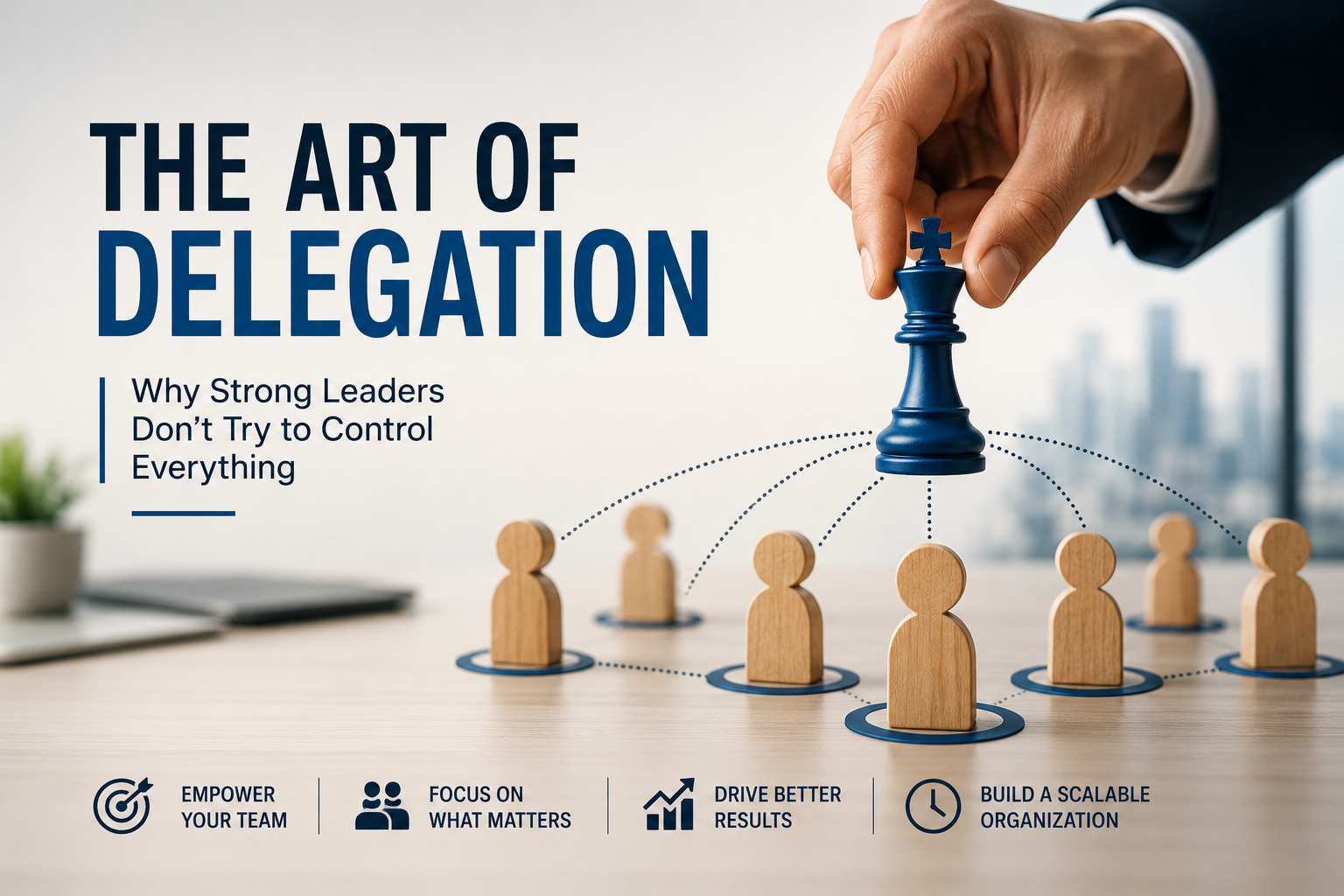
That is the real art of delegation.
From Doing the Work to Designing the Organisation
The transition from entrepreneur or functional leader to CEO requires a fundamental shift in mindset.
In the early stages of a company, founders often have to do everything. They know the customers, products, suppliers, finances and people personally. Speed comes from direct involvement.
But scale changes the equation.
What worked when a company had 20 employees can become disastrous when it has 20,000.
Leaders must therefore move from being the engine of execution to becoming the architect of execution.
Consider Satya Nadella at Microsoft. His leadership has been closely associated with empowering teams, encouraging collaboration and shifting the company’s culture away from internal competition toward a growth mindset. The lesson is bigger than one company: transformation at scale cannot depend on one leader making every decision.
Similarly, Ratan Tata became known for building institutions and empowering leaders across the Tata Group rather than attempting to personally run every business within a sprawling conglomerate.
The common thread is simple: great leaders multiply decision-making capacity.
Micromanagement Has a Hidden Cost
Micromanagement rarely announces itself as micromanagement.
It often arrives disguised as quality control.
“Send it to me before you release it.”
“Keep me copied on everything.”
“Let me approve this once.”
“Don’t make that decision without checking with me.”
Each instruction may appear reasonable in isolation. Together, they create an organisation where employees stop thinking independently.
The consequences are expensive.
Decisions slow down. Managers become cautious. Employees stop taking calculated risks. High performers become frustrated because they have responsibility without authority.
Eventually, the company develops a dangerous culture: people learn to manage the boss instead of managing the business.
Delegation Is a Test of Leadership
True delegation requires something many leaders struggle to give: trust.
But trust does not mean blind faith.
A strong leader delegates outcomes, not just tasks.
Instead of saying, “Prepare the expansion plan,” a CEO might give a business head ownership of entering a new market—with defined objectives, financial boundaries, timelines and measurable outcomes.
The leader does not dictate every step.
They establish the destination, define the guardrails and allow the team to determine the route.
That difference creates ownership.
And ownership creates leaders.
What Should a CEO Keep?
Delegation does not mean stepping away from everything.
A CEO should remain deeply involved in areas where their involvement has disproportionate value: corporate strategy, culture, capital allocation, leadership development, major risks and decisions that can materially alter the organisation’s future.
The question is not:
“What can I delegate?”
The better question is:
“Where does my involvement create the greatest value?”
Everything else deserves scrutiny.
If a capable executive can make a decision without the CEO, why is the CEO making it?
If a business unit cannot function for a week without the CEO’s intervention, is that a leadership problem—or an organisational design problem?
The Best CEOs Build Businesses That Don’t Depend on Them
This may sound counterintuitive, but the ultimate measure of a CEO’s effectiveness is not how indispensable they are.
It is how unnecessary they become in day-to-day decision-making.
That is particularly important as businesses become more complex. AI, global supply chains, geopolitical uncertainty, new regulations and rapidly changing customer expectations are increasing the number of decisions organisations must make.
One leader cannot possibly sit at the centre of all of them.
The winning organisations will therefore be those that push decision-making closer to the customer, the factory floor, the product team and the market—while maintaining strategic alignment from the top.
Leadership Is About Creating Capacity
Delegation is not about doing less work.
It is about doing higher-value work.
A CEO spending three hours reviewing an operational report may feel productive. Spending those three hours developing a future business leader, challenging the company’s strategy or identifying the next growth opportunity may create far greater value.
The strongest leaders understand this distinction.
They don’t build organisations around their personal ability to solve problems.
They build organisations capable of solving problems without them.
That is the difference between a leader who runs a business and a leader who builds an institution.
Because leadership is not the art of controlling everything. It is the discipline of knowing what only you can do—and having the courage to let others own everything else.